
Ask around and you will hear a fair version of this: "I have a Fonepay QR. Customers pay with eSewa, Khalti, their bank app, whatever they like. Why would I need anything else?"
It is a good question and the honest answer starts with agreement. For a lot of Nepali businesses, a Fonepay QR really is enough. This guide is about the specific points where it stops being enough, so you can tell which side of the line you are on instead of paying for something you do not need.
What a Fonepay QR already gives you
Credit where it is due, because this part gets undersold:
- It is interoperable. Fonepay QR uses the EMV merchant-presented QR standard, so it is not a Fonepay-only club. eSewa and Khalti apps can pay a Fonepay QR, and so can almost any Nepali bank app. Your customers do not need to hold a particular wallet.
- It starts at zero. Fonepay's published merchant-QR schedule is Rs 0 per transaction, and most Fonepay payments really are free. Not all of them: moving to instant settlement carries a per-settlement charge, and a card sitting behind a QR scan carries a percentage. Nothing else on the market starts from zero, but do not read that as never.
- It is regulated infrastructure. Fonepay is licensed by Nepal Rastra Bank as a Payment System Operator.
- It reaches visitors. Indian travellers can pay your Fonepay QR by UPI from PhonePe, BHIM or Google Pay, and Alipay+ wallets are accepted too. This is the one thing a Fonepay QR does that an eSewa or Khalti merchant account does not. It is not free: eSewa publishes a merchant charge of 1.95% per cross-border transaction, against Rs 0 domestic.
- Confirmation is instant, with no redirect and no waiting on a callback.
So if someone tells you QR is a lesser option, they are wrong. It is the default for good reason, and plenty of businesses never need more.
Where it stops being enough
Three places. None of them is a dealbreaker on its own, and how much each one matters depends entirely on who your customers are.
1. Cards, but only when the customer is scanning
Start by killing a myth, including one we used to repeat: a card can fund a QR scan. Some Nepali bank apps let a credit card sit behind the scan, and Visa's Scan to Pay lets a foreign Visa cardholder with a tokenised card in their wallet app pay a Fonepay QR. "QR does not do cards" is too strong.
What a QR cannot do is take a card the way a website does: the customer typing their card number into your checkout. There is no field to type into on a QR code. Every card route into a QR runs through an app the customer already has and a code they can physically scan.
That is the whole problem online. Someone ordering at midnight from Pokhara, or from abroad with nothing but a card, is not scanning anything.
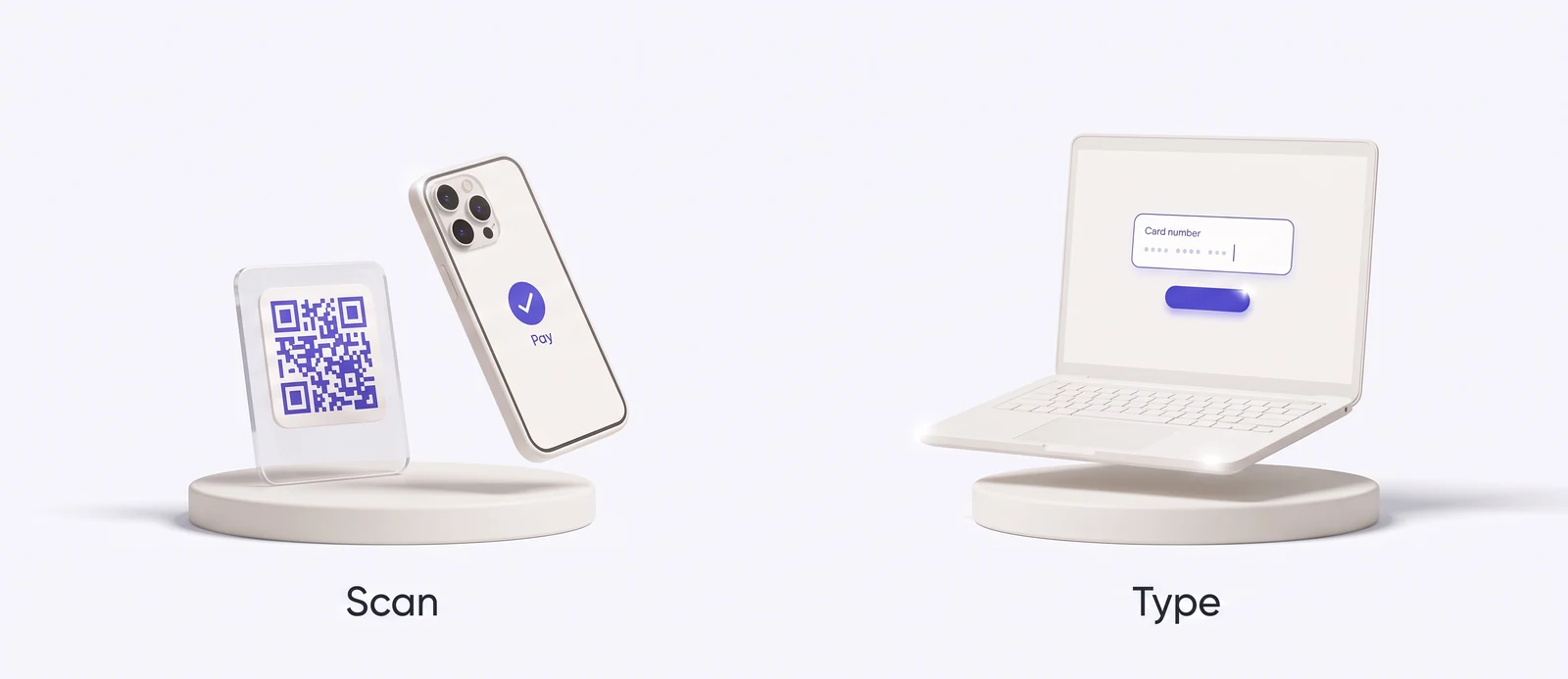
A card machine is the counter version of this, not the online one. Whether it is a traditional POS terminal or one of the newer SoftPOS apps that turn a phone into one, the customer has to be standing in front of you to tap or insert a card.
Taking a typed card online means a checkout built for card-not-present payments. Khalti's flow covers that, along with ebanking and mobile banking. It also includes ConnectIPS inside Khalti's own flow, though ConnectIPS is not yet available as a separate PayBridgeNP provider.
2. The one-tap deeplink does not cover wallets
A QR assumes two screens: the one showing the code and the one scanning it. That is fine at a counter. It is awkward when your customer is already on their phone, on your website, looking at the QR on that same screen.
It is not impossible. People screenshot the QR and upload it from their gallery inside the wallet app, and this happens constantly. But it is four steps where a redirect is one, and every extra step at checkout costs you some buyers.
Deeplinks are the fix, and here is the part most people miss: they are not interoperable the way the QR is. Fonepay's "open in your app" deeplink pre-fills the amount for a set of onboarded bank apps. For eSewa and Khalti it only opens the app, and the customer still has to scan. eSewa Intent, by contrast, opens the eSewa app with the amount already filled in.
So a Fonepay QR alone cannot give an eSewa wallet customer a one-tap payment on their own phone. Only eSewa can.
3. Refunds work differently on each rail
If you sell things people send back, this matters more than it sounds.
Khalti is the only one of the three with an automated refund API. eSewa has no refund API at all, so refunds are done by hand in eSewa's own portal and then confirmed. Fonepay refunds are automated from the PayBridgeNP dashboard, full refunds only, and not available through the API.
None of this is a reason to avoid a provider. It is a reason to know which one you are standing on before a customer asks for money back.
A simple test
Answer honestly:
- Customers standing in front of you. A Fonepay QR is enough. Add a card machine if you want cards over the counter.
- Customers on your website, all in Nepal, all paying from a wallet or bank app. A Fonepay QR is enough, as long as it is generated per order rather than printed.
- Anyone who wants to type a card number instead of scanning. You need an online card checkout. A QR gives them nothing to type into, whatever card they hold.
- You want the eSewa crowd paying in one tap on their phone. You need eSewa alongside Fonepay.
- You refund often. Know your rail before you need it.
Most Nepali businesses selling online land in the second or third case. That is why plenty start with Fonepay only and add a wallet later, when a real customer asks for something Fonepay cannot do.
Adding a second provider without doing the work twice
The reason merchants stop at one is rarely the fee. It is that each provider means its own merchant application, its own credentials, its own code, its own webhooks, and its own dashboard to reconcile at month end. Doing that twice is genuinely worse than doing it once.
PayBridgeNP removes that part. You integrate once and accept eSewa, Khalti and Fonepay through a single API and one dashboard, with a checkout you can host with us, embed in your own page, or send as a link. Adding a provider later is a dashboard setting, not a rewrite. Every payment settles straight to your own provider merchant accounts, PayBridgeNP never holds your funds, and there is a 0% platform fee on top of the providers' own rates.
Which means you can start with Fonepay only, exactly as this guide suggests, and add a wallet the day a customer actually needs one.
Frequently asked questions
Can eSewa and Khalti users pay my Fonepay QR?
Yes. Fonepay QR follows the EMV merchant-presented QR standard, and eSewa and Khalti apps can both pay it, along with most Nepali bank apps. This is why the "I already have a Fonepay QR" argument is a reasonable one.
Can I accept card payments with a QR?
Only if the customer is scanning. A card can sit behind a Nepali bank app's scan, and Visa's Scan to Pay lets a foreign Visa cardholder pay a Fonepay QR from their wallet app. What a QR cannot do is take a typed card number, because there is no field to type one into. For that you need a checkout built for card-not-present payments, which on PayBridgeNP means Khalti. Over the counter, a card machine handles it.
Is Fonepay QR free?
Mostly, and that is the honest version. Fonepay's published merchant-QR schedule is Rs 0 per transaction, and the overwhelming majority of Fonepay payments carry no charge at all. Three exceptions. Two we have measured: switching to instant settlement carries a per-settlement charge, and some banks let a card sit behind a QR scan, which carries a percentage. The third is published rather than measured: cross-border payments from UPI or Alipay+ wallets carry 1.95% to the merchant, which is the price of being payable by visitors.
Either charge reaches you on the settlement report after the payment, not at checkout. So read the report rather than assuming every Fonepay payment was free.
Do I need eSewa and Khalti merchant accounts if I have Fonepay?
Not to be paid by eSewa and Khalti users, because their apps can pay your Fonepay QR. You need them for cards, for one-tap wallet payments on a customer's own phone, and for an automated refund API. If none of those apply, Fonepay alone is a sensible place to stay.
Next steps
- Compare the three head to head: eSewa vs Khalti vs Fonepay.
- Understand the layers: checkout vs payment gateway.
- Selling without a website? Payment links are a checkout as a URL.
- Start free in the PayBridgeNP dashboard.