
Talk to enough Nepali business owners about going online and you hear the same two words used for everything: "checkout" and "payment gateway". A store owner says they need "eSewa checkout". A developer says they are integrating "the Khalti gateway". A friend suggests "just add a payment gateway" as if it were one purchase.
They are different layers, and knowing where one ends and the next begins saves you from buying the wrong thing, or debugging the wrong layer when payments start failing.
The short version
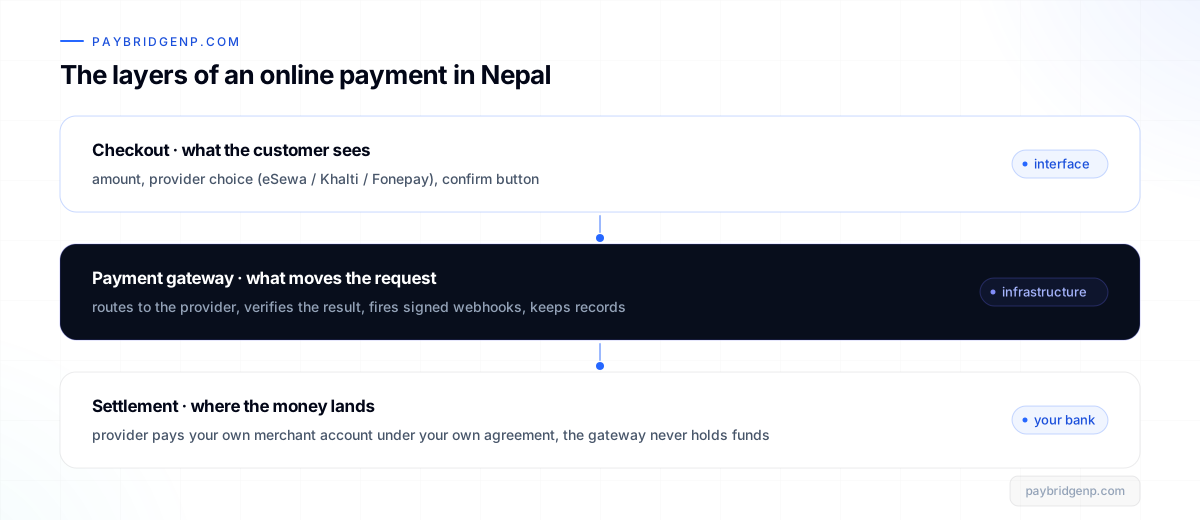
- The checkout is what the customer sees: the page where they review the amount, pick how to pay, and confirm. It is a user interface.
- The payment gateway is what moves the request: the system that connects that page to the payment networks, routes the transaction, confirms the result to your server, and keeps the records straight. It is infrastructure.
The customer meets your checkout. Your business relies on the gateway. When a payment fails at the "choose provider" screen, that is a checkout problem. When the customer paid but your order still says pending, that is a gateway-layer problem.
Payment gateway, meaning, in plain terms
Since a lot of people search exactly this: a payment gateway is the bridge between a paying customer and the business's account. In Nepali terms: payment gateway भनेको ग्राहक र व्यवसायको बीचमा रकम सुरक्षित रूपमा पुर्याउने पुल हो। The customer pays through eSewa, Khalti or their bank app; the gateway carries that payment safely to the business, confirms it really happened, and keeps the record.
The word to separate it from is "wallet". eSewa and Khalti are wallets first: apps where people keep money. A gateway holds nothing; it routes and verifies. Which leads to the next confusion.
So what are eSewa, Khalti, and Fonepay?
Each one is more than one thing, which is why the vocabulary gets slippery:
- eSewa is a wallet for its users. For businesses, it also offers its own gateway-style APIs (ePay, Intent) to accept eSewa payments specifically.
- Khalti is a wallet too, and its own gateway product also accepts ebanking, mobile banking, ConnectIPS and card payments inside Khalti's flow (ConnectIPS is not yet available as a separate PayBridgeNP provider).
- Fonepay is not a wallet at all. It is a payment network: the QR system that lets any mobile banking app pay any enrolled merchant.
Notice what none of them gives you: one checkout where the customer picks between all of them. Integrating each provider gives you three separate flows, three verification models and three dashboards, stitched together on your side. That stitched-together layer is exactly what PayBridgeNP is: one checkout and one gateway API that carries eSewa, Khalti, and Fonepay together, confirms every payment with signed webhooks, and settles the money to your own provider accounts. We hold nothing; we route and verify.
Which parts does your business actually need?
Work bottom-up from how you sell:
- Selling in DMs, no website: you need a checkout the customer can reach from a link, and nothing else visible. Payment links are literally a checkout-as-a-URL, with the gateway invisible behind it. More in accepting payments without a website.
- A store on Shopify or WooCommerce: your platform already renders the cart; you need the checkout and gateway plugged into it. The integrations drop both in without code.
- A custom site or app: you need the gateway API, and you choose between a ready-made hosted checkout or building your own UI on top. Hosted is the right default; it is where provider quirks, QR display and retries are already handled.
- High volume, multiple channels: you need the layer above the gateway too: one dashboard, refunds, reconciliation and webhooks your systems can trust.
Where problems actually live
The practical payoff of separating the layers is faster debugging:
| Symptom | Layer | Where to look |
|---|---|---|
| Customer never reaches a payment page | Checkout | Broken link, wrong session, page error |
| Customer abandons at provider choice | Checkout | Too few providers enabled, confusing flow |
| Provider app says paid, order says pending | Gateway | Verification and webhook handling |
| Payment succeeded twice for one order | Gateway | Idempotency, duplicate sessions |
| Money confirmed but not in your bank yet | Neither | Provider settlement timing, see Fonepay's options |
That last row matters: settlement is a third layer, between the provider and your bank, governed by your merchant agreement. A gateway that never holds funds cannot delay them either.
Frequently asked questions
Is eSewa a payment gateway? eSewa is primarily a wallet, and it offers its own APIs for businesses to accept eSewa payments. It does not give you Khalti or Fonepay; a multi-provider gateway sits above all three.
Do I need a payment gateway if I have a checkout page? A checkout page without a gateway is a form that cannot move money. Every real checkout has a gateway behind it; the question is whether you build that connection per provider or use one that carries all of them.
What is a payment gateway in Nepali? Payment gateway भनेको अनलाइन भुक्तानीलाई ग्राहकबाट व्यवसायसम्म सुरक्षित पुर्याउने प्रणाली हो। ग्राहकले eSewa, Khalti वा बैंक app बाट तिर्छ, gateway ले त्यो भुक्तानी रुट गरेर पुष्टि गर्छ।
Does PayBridgeNP hold my money? No. Payments settle directly to your own eSewa, Khalti, and Fonepay merchant accounts under your own agreements. PayBridgeNP routes, confirms and records; it never holds funds.
Next Steps
- New to all of this? Start with what is a payment gateway, the longer primer.
- Pick your entry point: links, buttons or hosted checkout.
- Compare the providers behind the gateway: eSewa vs Khalti vs Fonepay.
- Start free in the PayBridgeNP dashboard.