
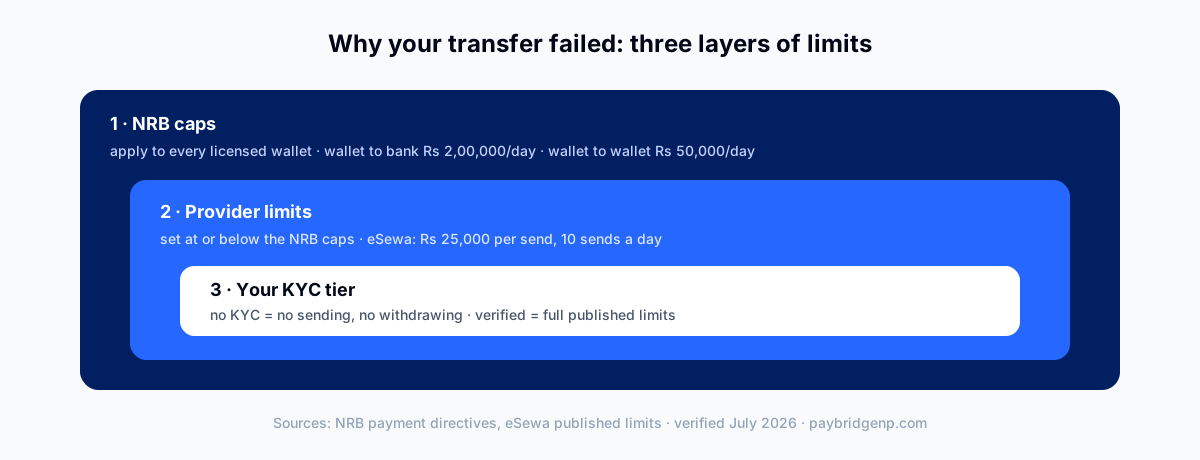
"Why did my transfer fail?" In Nepal the answer is usually a limit you did not know existed. Wallet limits come in three layers, and most confusion comes from mixing them up:
- Nepal Rastra Bank caps, which apply to every licensed wallet in the country.
- The provider's own published limits, like eSewa's transaction limit schedule.
- Your KYC tier, which decides whether you get those limits at all.
This guide walks through each layer with the published numbers, then covers the question that matters for businesses: do these limits stop a customer from paying you?
Last verified: July 2026. Limits change by NRB directive and provider notice, so check the linked sources if you are reading this much later.
The quick answers
| Question | Answer |
|---|---|
| eSewa send limit per day | Rs 50,000 wallet-to-wallet, max 10 transactions (eSewa's schedule) |
| eSewa limit per transaction | Rs 25,000 wallet-to-wallet, Rs 50,000 wallet-to-bank |
| eSewa limit without KYC | You cannot send or withdraw at all until you complete KYC |
| Wallet-to-bank limit (all wallets) | Rs 200,000 per day, Rs 10,00,000 per month (NRB cap) |
| QR payment limit | Depends on the rail: wallet QR follows wallet limits, bank-app QR follows your bank's mobile banking limits |
| Limit when paying a merchant | eSewa lists no separate cap on paying billed merchants |
Layer 1: the NRB caps every wallet follows
Nepal Rastra Bank sets ceiling limits for all licensed wallets (eSewa, Khalti, and the rest) through its payment systems directives. The widely reported caps (GadgetByte's breakdown):
| Movement | Per day | Per month |
|---|---|---|
| Bank to wallet (loading) | Rs 200,000 | Rs 10,00,000 |
| Wallet to bank (withdrawing) | Rs 200,000 | Rs 10,00,000 |
| Wallet to wallet (sending) | Rs 50,000 | Rs 5,00,000 |
A provider can set its own limits below these caps, and most do. Which brings us to layer 2.
Layer 2: eSewa's published limits
eSewa is the one major wallet that publishes a full limit schedule. From their official revision notice, for KYC-verified users:
| Transaction | Per transaction | Per day | Per month |
|---|---|---|---|
| Send to another wallet | Rs 25,000 | Rs 50,000 (10 transactions) | Rs 5,00,000 (100 transactions) |
| Wallet to bank withdrawal | Rs 50,000 | Rs 2,00,000 (10 transactions) | Rs 10,00,000 (50 transactions) |
| Load via linked bank account | Rs 50,000 | Rs 1,00,000 | Rs 10,00,000 |
| Cash in through an agent | Rs 10,000 | Rs 25,000 | Rs 1,00,000 |
Note how the wallet-to-bank and load numbers sit exactly at or under the NRB caps from layer 1. That is the pattern across the industry.
Paying merchants is the exception. eSewa's schedule states users can pay billed merchant amounts without a separate specified limit. Your grocery run, your school fee, your online checkout: these do not eat into the send-money caps above.
Layer 3: KYC decides everything
The numbers above are for verified accounts. Without KYC, eSewa accounts are close to frozen:
- No sending money to other wallets.
- No withdrawing to a bank.
If you searched "esewa limit without kyc" hoping for a workaround: there is not one, and that is deliberate. Complete KYC in the app (citizenship or ID photo plus a selfie; how long verification takes varies) and the full limits unlock. The same applies to Khalti and every other licensed wallet, because the KYC requirement comes from NRB, not the provider.
What about Khalti's limits?
Khalti operates under the same NRB caps but does not publish a detailed public schedule the way eSewa does. Your current limits are shown inside the Khalti app, and Khalti's support pages cover specific cases. As a rule of thumb, expect the same shape: KYC required for sending and withdrawing, per-day and per-month ceilings within the NRB caps.
QR payment limits: which rail are you on?
"QR payment limit in Nepal" has two different answers because QR runs on two different rails:
- Wallet QR (paying through the eSewa or Khalti app): the wallet's own limits apply, as above. Merchant payments generally avoid the P2P caps.
- Bank-app QR (scanning Fonepay or NepalPay QR from your mobile banking app): the money moves from your bank account, so your bank's mobile banking limits apply, under NRB's mobile banking rules. These are typically higher than wallet limits and vary bank to bank, so the exact figure lives in your bank's app or schedule of charges.
This split is worth remembering as a merchant: a customer who hits a wallet limit can often still pay you by scanning the same purchase through their banking app.
What limits mean for your business
For most day-to-day commerce, limits are a buyer-side concern and payments to merchants flow without special caps. Where they bite:
- High-ticket sales. A Rs 80,000 laptop is above eSewa's Rs 25,000 wallet-to-wallet cap, but that cap is for P2P sends, not merchant checkout. Still, buyers' load limits and balances make large wallet payments awkward. For big amounts, bank rails work better: Fonepay QR from a banking app, or a direct ConnectIPS transfer (ConnectIPS is not yet available as a PayBridgeNP checkout provider).
- Collecting into a personal wallet. If you run your business through personal send-money transfers, every one of those caps above applies to you, plus the Rs 10 fee beyond the free allowance. A proper merchant setup avoids both.
- Offering only one method. Any single rail can hit a limit or an outage. Accepting eSewa, Khalti, and Fonepay together through one integration means a blocked customer has a second way to pay before they give up.
Frequently asked questions
What is the eSewa limit per day? For verified users: Rs 50,000 per day for wallet-to-wallet sends (max 10 transactions) and Rs 2,00,000 per day for wallet-to-bank withdrawals.
What is the eSewa limit without KYC? Unverified accounts cannot send money or withdraw to a bank at all. Complete KYC to unlock normal limits.
How do I increase my eSewa or Khalti limit? Complete KYC verification. The published limits are fixed by the provider and NRB, so beyond KYC there is no personal limit increase to request.
Is there a limit when customers pay my store? eSewa lists no separate cap for paying billed merchants. Buyers are still bounded by their balance and load limits, so offer a bank-rail option for high-value sales.
Do these limits apply to Fonepay QR? Fonepay QR paid from a mobile banking app follows the customer's bank limits, not wallet limits. Fonepay QR paid from a wallet app follows that wallet's limits.
Next Steps
- Accept eSewa, Khalti, and Fonepay together: how PayBridgeNP works.
- High-value sales? Read the ConnectIPS guide for the bank-transfer rail.
- Compare the providers first: eSewa vs Khalti vs Fonepay.
- Start free in the PayBridgeNP dashboard.
Sources
- eSewa: Revision in Transaction Limits, official schedule, verified July 2026.
- GadgetByte: Nepal Rastra Bank transaction limits, reporting on NRB's payment systems directives.
- eSewa Tariffs for the charges that pair with these limits.